Maintenance Guide · Detroit, MI
How to Keep a Porta Potty Clean: Maintenance Guide
For renters, event organizers, and job-site managers · 7 min read
Nobody rents a porta potty hoping it’ll be the highlight of the day. But here’s what most people learn the hard way: the difference between a portable restroom that’s perfectly fine and one that makes everyone miserable has almost nothing to do with luck — and everything to do with maintenance.
A well-kept unit is clean, stocked, and forgettable in the best way. A neglected one? You’ll hear about it from your crew, your guests, or your wedding photographer. This guide covers what professional servicing actually includes, how often units need it, and the simple things you can do between service visits to keep everything fresh.
What a Service Visit Actually Includes
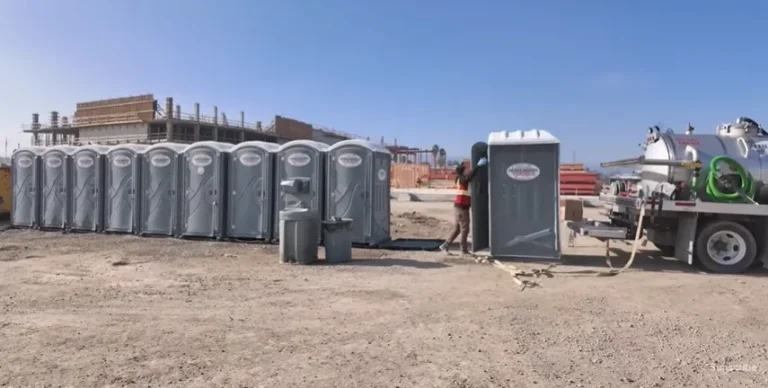
When a service truck pulls up to your unit, the technician isn’t just “emptying it.” Every professional servicing follows the same four-step routine, and it takes about five to ten minutes per unit:
- Pump-out. A vacuum hose empties the waste tank — around 60 gallons on a standard unit. Over in a couple of minutes.
- Scrub and sanitize. Seat, urinal, walls, floor, and door handle get washed down with sanitizing cleaner.
- Recharge. Fresh water goes back in with the blue deodorizing solution. That blue liquid isn’t for show — it controls odor, slows odor-causing bacteria, and keeps tank contents out of sight.
- Restock and inspect. Toilet paper and hand sanitizer are refilled; the door, latch, and vent stack get checked.
Waste goes to a municipal treatment facility through a proper disposal chain. Now you know what to expect: if a “service” is just a quick pump with no restock, you’re not getting the full job.
How Often Should Units Be Serviced?
The honest answer: it depends on how hard the unit is working. The industry baseline is once a week — a standard unit handles roughly 200 uses between services. Here’s the practical breakdown:
| Situation | Recommended servicing |
|---|---|
| Job site, up to 10 workers per unit | Once a week |
| Job site, 11–20 workers per unit | Twice a week |
| Single-day event or wedding | Cleaned before delivery |
| Multi-day festival or fair | Every 8–12 hours |
| Long-term placement (months) | Weekly, adjusted for crew size |
Heat and crowds move you off the baseline fast: a July week in Detroit eats through a deodorizer charge quicker than an October week, and a 40-person crew needs more attention than eight. If you’re setting up construction porta potty rental in Detroit, build the schedule around your actual headcount. For multi-day gatherings, scheduled mid-event servicing is what keeps day three feeling like day one — standard on our event porta potty rental packages for anything longer than a single day.
Pro tip: When in doubt, add the extra visit — an overflowed unit costs far more in downtime and morale than a second weekly service.
Not sure what service schedule your rental needs?
One call and we’ll match servicing to your crew, guest count, or event length.
📞 Call (313) 385-3332
Mon–Sat 7AM–7PM · Sun 7AM–12PM · 24/7 Emergency Service
What You Can Do Between Service Visits
The crew handles the heavy lifting, but what happens between visits is on you — where most odor problems start:
- Keep the door closed. The single easiest win: the vent stack pulls odor up and out on rising warm air — an open door breaks that airflow and lets every smell drift out at nose level.
- Don’t treat the tank like a trash can. Cups, wrappers, and debris go in a trash bin, not the toilet. Trash in the tank clogs the vacuum hose at pump-out time and turns a five-minute service into a much longer ordeal.
- Put a trash bin beside the unit. If there’s nowhere else for trash to go, it ends up in the tank. A five-dollar bin solves a surprising number of problems.
- Report low supplies early. Don’t wait until the toilet paper runs out on a Friday afternoon — a quick call gets a restock scheduled before it becomes a problem.
- Keep the service path clear. The vacuum truck needs to reach the unit with a hose. Don’t block the access route with equipment, dumpsters, or pallets.
- Lock it overnight on job sites. A simple latch lock keeps after-hours visitors out and your supply levels predictable.
What Never Goes in the Tank
Well-meaning people get this one wrong all the time:
Do NOT add:
- Bleach, pine cleaner, or lime. They fight the blue deodorizing chemistry — and the smell gets worse, not better.
- Feminine hygiene products. They don’t break down; they jam pump equipment.
- “Flushable” wipes. Not in a 60-gallon holding tank — they clog hoses.
- Paint, solvents, or chemicals — the tank is for human waste and toilet paper, full stop.
If a unit smells bad between visits, the answer is almost never “pour something in it” — it’s usually a service visit, a closed door, or both.
Beating the Heat: Odor Control in a Michigan Summer
July and August in metro Detroit are the real test. Heat speeds up the bacterial activity that causes odor, and a deodorizer charge that lasts a full week in October works overtime by mid-July. What genuinely helps:
- Use shade when you can. Direct sun bakes the tank. A spot under a tree line or on the shaded side of a structure makes a noticeable difference.
- Don’t tarp the roof. It seems logical, but the vent stack needs clear airflow — a tarp traps odor inside instead of letting it draft up and away.
- Add a second weekly visit in summer on high-use sites. It’s the most effective odor control there is — more effective than any additive.
- Keep the door closed — it matters twice as much in August.
Placement Matters More Than People Think
Where the unit sits affects cleanliness — and whether anyone wants to use it:
- Level ground, always. A tilted unit is uncomfortable, the door won’t latch right, and the tank sits unevenly. Flat and firm beats convenient-but-sloped.
- Downwind of gathering areas, within easy walking distance. Not next to the food table, not a five-minute hike — thirty to sixty seconds on foot is the sweet spot.
- Truck-accessible. The tech needs to run a hose from the truck to the unit. Don’t make them drive across your lawn or staging area to get there.
- Lit at night if the site runs past sunset — for safety, and because people are tidier when they can see.
Getting placement right on day one prevents most headaches later. Planning a wedding? Our wedding restroom planning guide covers venue placement in more detail — same rules, plus a few extras for photos and guest flow.
A Quick Word on Winter Rentals
Detroit winters are no joke, and neither is a frozen holding tank. Renting November through March? Mention it when you call — winterized units and adjusted servicing keep everything working in a deep freeze. It’s routine; just don’t skip the conversation.
When to Call for an Extra Service
Even on a good schedule, call sooner if you notice:
- Strong odor within a day or two of a service visit
- The tank looking close to full
- Supplies running out faster than expected
- A broken door, latch, or lock — or a tipped or vandalized unit
An extra pump-out costs far less than the alternative — waiting is never the right call.
Maintenance FAQs
How often does a porta potty need to be pumped?
Typical use — up to 10 workers or a lightly used unit — once a week. Heavier use: twice a week or more. A standard 60-gallon tank handles roughly 200 uses between pump-outs.
What is the blue liquid in the tank?
A deodorizing and sanitizing solution, refreshed at every service visit. It controls odor, slows odor-causing bacteria, and tints tank contents out of sight. Don’t add bleach or household cleaners — they interfere with it and make odor worse.
Can I clean the unit myself between service visits?
Light tidying is fine — wipe the seat, pick up trash, keep the area clear. Leave the tank, the deodorizer chemistry, and the pump-out to the service crew. DIY chemicals usually make things worse.
What happens if servicing is skipped or delayed?
The tank fills past working capacity, odor builds fast, supplies run out — and you risk an overflow: a health issue and, on a job site, a compliance problem. If a visit will be late, call ahead.
Do units need servicing during a one-day event?
No — units arrive deep-cleaned and fully stocked, which covers a single day. Multi-day events get mid-event servicing every 8–12 hours.
Who do I call if a unit tips over or gets damaged?
Call your rental provider right away — (313) 385-3332 if it’s one of ours. A tipped unit needs professional uprighting; don’t try to right a full one yourself.
Keep Every Unit Clean, All Rental Long
Wayne, Oakland & Macomb counties · Weekly, event & emergency servicing
📞 Call (313) 385-3332
Mon–Sat 7AM–7PM · Sun 7AM–12PM · 24/7 Emergency Service
Porta Potty Rental Detroit MI · 2211 Woodward Ave Suite 300, Detroit, MI 48201 · Serving Southeast Michigan