DETROIT EVENT & JOBSITE GUIDE
5 min read | Detroit, MI | Porta Potty Guide
Need Units Fast? Call (313) 385-3332
How Many Porta Potties Do I Need? [2026 Calculator]
If you are asking “how many porta potties do I need,” you are already ahead of most planners. The number of portable toilets can make or break an outdoor event or keep a construction crew productive — and guessing wrong usually means long lines, unhappy guests, or a compliance headache on a job site. The good news is that the math behind it is simple once you know the industry’s standard ratios.
This 2026 calculator guide walks you through the per-person formulas, a ready-to-use event chart, the OSHA rules for construction sites, and how many ADA-accessible units to include — all with a Detroit, Michigan angle, from Belle Isle weddings to downtown job sites and Lions tailgates.
In This Guide
- How Many Porta Potties Do I Need? The Quick Answer
- 2026 Event Calculator: How Many Porta Potties Do I Need
- Construction Sites: OSHA Rules for How Many Porta Potties You Need
- 7 Factors That Change Your Count
- ADA-Accessible Units: How Many Do You Need?
- Detroit Events: Putting the Numbers to Work
- Placement and Servicing Tips
- Frequently Asked Questions
- Get the Right Count for Your Detroit Event or Job Site
How Many Porta Potties Do I Need? The Quick Answer
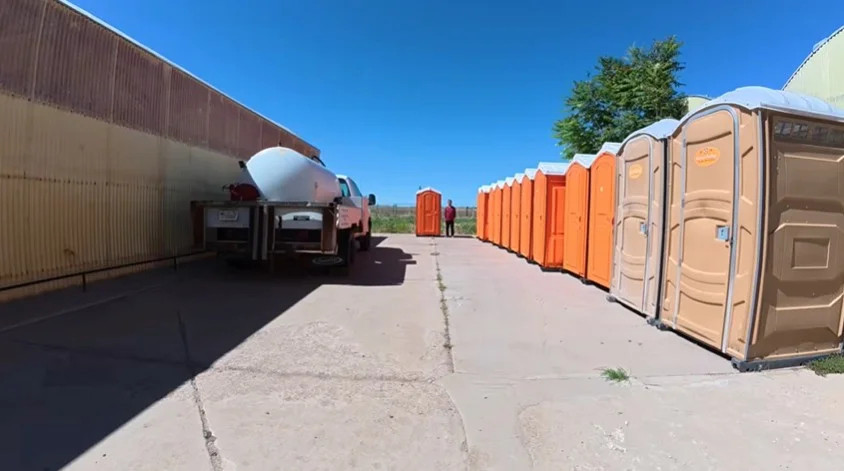
For most events lasting about four hours, the industry starting point is one porta potty per 50 guests. That single ratio answers the question “how many porta potties do I need” for the majority of planners: 100 guests for four hours means 2 units, 200 guests means 4 units, and so on.
Construction sites work differently. Federal OSHA rules set legal minimums by crew size, but most contractors plan around one unit per 10 workers on a standard 40-hour week to keep lines short during breaks.
And one more number that matters everywhere: where units are clustered in one location, at least 5% of them — and never fewer than one — should be ADA-accessible.
2026 Event Calculator: How Many Porta Potties Do I Need
Use this chart as your calculator. Find your guest count, then adjust for how long the event runs. The baseline assumes a four-hour event with no alcohol.
| Guests | 1-4 Hours | 4-8 Hours | 8+ Hours / All Day |
|---|---|---|---|
| 1-50 | 1 | 2 | 3 |
| 51-100 | 2 | 3 | 4 |
| 101-250 | 4 | 6 | 8 |
| 251-500 | 8 | 10 | 12 |
| 501-1,000 | 12 | 16 | 20 |
| 1,000+ | 20+ (call for a plan) | 25+ | 30+ |
How to use this calculator in three steps:
- Start with your headcount. Include staff, vendors, volunteers, and security — not just ticketed guests. A 200-person festival with 25 workers is really a 225-person restroom plan.
- Find your duration column. Longer events mean more trips per guest. An all-day event at Hart Plaza needs roughly double the units of a four-hour version of the same crowd.
- Adjust for the multipliers below. Alcohol service alone typically increases usage by 15-20%, so a beer-tent event with 200 guests should plan closer to 5-6 units for four hours rather than the baseline 4.
Add one handwashing station for every four porta potties — and always more where food is served, such as Eastern Market food festivals or food-truck rallies.
Pro Tip: Count everyone, not just ticketed guests. Staff, vendors, volunteers, performers, and security all use the restrooms — a 200-person festival with 25 workers is really a 225-person restroom plan. Undercounting headcount is the most common reason lines form.
Construction Sites: OSHA Rules for How Many Porta Potties You Need
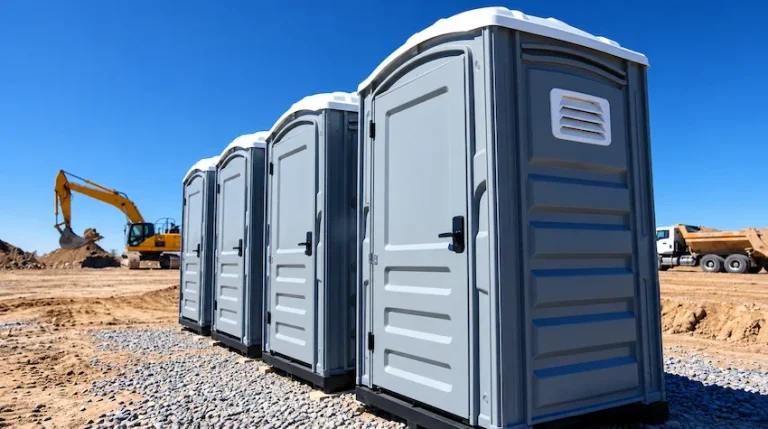
On a job site, the count is not a suggestion — it is a legal requirement. Federal OSHA’s construction sanitation standard (29 CFR 1926.51) sets minimum toilet counts based on crew size, and Michigan’s MIOSHA program enforces equivalent rules on Detroit-area sites. If you are arranging portable sanitation for a construction site, start with these legal minimums:
| Workers on Site | OSHA Minimum |
|---|---|
| 20 or fewer | 1 toilet |
| 21-199 | 1 toilet seat and 1 urinal per 40 workers |
| 200 or more | 1 toilet seat and 1 urinal per 50 workers |
Those are minimums, and most Detroit contractors go well beyond them. The industry rule of thumb is one unit per 10 workers for a standard week — because a crew standing in line at 7 a.m. is a crew not working. Units should also sit within about 200 feet of the work area, on firm, level ground, with a clear path for the service truck.
Detroit’s construction scene — downtown high-rises, midtown rehabs, highway and infrastructure work — often runs multi-trade crews on tight schedules. For those sites, many supers order one extra unit beyond the math as a buffer for peak days, plus handwashing stations near the lunch and break areas.
Pro Tip: OSHA minimums are a legal floor, not a comfort target. Most Detroit-area contractors plan one unit per 10 workers and add one extra unit as a buffer for peak days — a crew waiting in line at 7 a.m. is a crew not working.
On a Michigan construction site the legal minimums come from MIOSHA, not the federal table — our guide to OSHA toilet requirements for construction (https://portapottyrentaldetroitmi.com/osha-toilet-requirements-construction/) works through the Michigan numbers.
7 Factors That Change Your Count
The chart above is a starting point. Before you finalize, run through these seven factors — each one can push your number up:
- Event duration. Every hour past four adds trips. Add roughly one unit per 50 guests for each additional block of time.
- Alcohol service. Beer, wine, and cocktails increase restroom visits noticeably — plan 15-20% more units for events with a bar.
- Food and beverages. Heavy food and drink service (think food-truck festivals) drives more traffic than a program with no concessions.
- Hot weather. Guests drink more water in July heat, which means more restroom use. Detroit summers regularly hit the 80s and 90s.
- Families with children. Kids need the restroom more often and take longer inside the unit.
- Staff and vendors. Workers, volunteers, performers, and security all need access — count them.
- Unit placement. Spread units across the venue instead of clustering them all in one spot. Lines move faster when people have two or three places to go.
When several factors stack up — say, an all-day August festival with alcohol and food vendors on Belle Isle — rounding up is always cheaper than the alternative: long lines and unhappy guests.
Note: Stacking factors multiply fast. An all-day August festival with alcohol and food vendors needs far more than the baseline chart suggests — when several factors apply at once, rounding your count up is always cheaper than long lines and unhappy guests.
ADA-Accessible Units: How Many Do You Need?
Under the ADA Standards for Accessible Design, where portable toilets are clustered at a single location, at least 5% of the units — and never fewer than one — must be wheelchair-accessible. So a 200-guest event with 4 standard units needs at least 1 ADA unit; a 500-guest event with 10 units needs at least 1, though 2 spread across two locations is smarter. Review the ADA-accessible unit requirements to confirm how many accessible units your event needs.
ADA units are larger (roughly a 5×5 to 6×6 footprint plus maneuvering room), so plan extra space. Place them on firm, level ground along accessible pathways — near parking, main entrances, and food areas — never at the bottom of a slope or behind a curb. For public events in Detroit, from riverfront concerts to neighborhood block parties, at least one accessible portable toilet is simply non-negotiable.
Note: The 5% ADA rule applies wherever units are clustered at one location — and it is never fewer than one accessible unit. ADA units need a larger footprint (about 5×5 to 6×6 plus maneuvering room), so plan extra space on firm, level ground along accessible pathways.
Detroit Events: Putting the Numbers to Work
A few local scenarios to make the math concrete:
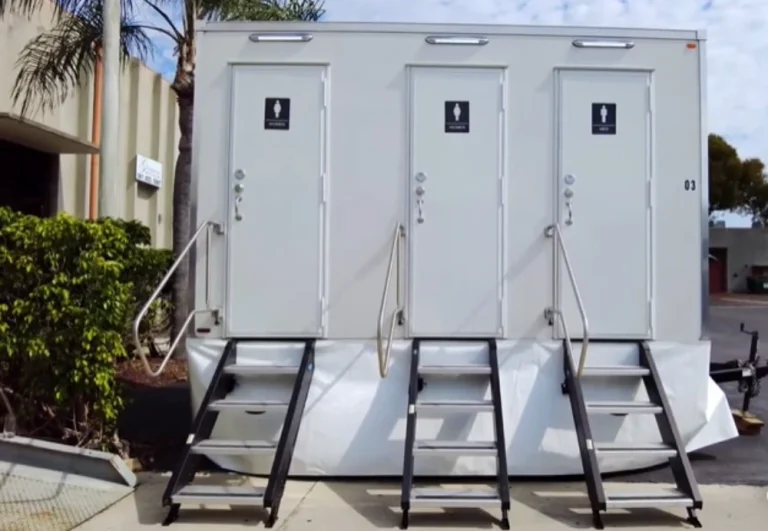
- Belle Isle wedding, 120 guests, 6 hours, dinner and drinks: Start at 3-4 units for the guest count and duration, add for alcohol, and include 1 ADA unit plus 1-2 handwashing stations. Many couples upgrade one unit to a restroom trailer for the bridal party.
- Hart Plaza festival, 800 attendees, all day, beer tents: Baseline 12-16 units, then scale up for duration and alcohol — 18-20 standard units plus 2 ADA units and handwashing stations near every food area is a realistic plan.
- Lions tailgate, 60 people, 5 hours: 2 units plus a handwashing station keeps the pregame comfortable.
- Downtown construction crew, 25 workers, 3-month project: OSHA minimum is 1, but the 1-per-10 rule of thumb means 2-3 units, serviced weekly, with a handwashing station.
Placement and Servicing Tips
Where units go matters almost as much as how many you order:
- Place units on firm, level ground away from low spots that collect water after a Michigan rain.
- Keep a clear path for service trucks — units need weekly pumping and cleaning on longer rentals.
- Add lighting near units for evening events.
- Anchor units in windy conditions (open riverfront sites get gusty).
- For multi-day events, schedule mid-event servicing so units stay clean for day two.
Available 7 Days in Detroit
- Local providers serving Detroit and the metro area – open Mon-Sat, 7AM-7PM · Sun 7AM-12PM
- Standard, ADA-accessible, and restroom trailer options for any crowd size
- Emergency and same-day delivery when your plans change fast
Frequently Asked Questions
How many porta potties do I need for 100 guests?
For a four-hour event, plan 2 standard units plus 1 ADA-accessible unit. Add more for longer events, alcohol service, or hot weather.
How many people can one porta potty handle?
The standard planning figure is 50 people per unit for about four hours. Weddings and upscale events often plan closer to 25-35 people per unit for extra comfort.
Do construction sites need more porta potties than events?
They follow different rules. Sites use OSHA minimums by crew size, but most contractors plan one unit per 10 workers — well above the legal minimum — to avoid lines during breaks.
Get the Right Count for Your Detroit Event or Job Site
So, how many porta potties do you need? Start with one unit per 50 guests for events, one per 10 workers for construction, and at least one ADA-accessible unit — then adjust for duration, alcohol, weather, and crowd. Once your count is set, see our 2026 porta potty rental pricing guide for Detroit to understand typical market ranges by unit type.
Planning an event or job site in Detroit? Call Porta Potty Rental Detroit MI at (313) 385-3332 — Mon-Sat 7AM-7PM · Sun 7AM-12PM, 24/7 emergency service. We’ll connect you with local providers who can confirm your count, deliver on schedule, and keep every unit serviced.
Ready to Book? Call (313) 385-3332
Talk to a local specialist today – confirm your unit count, check availability, and get delivery scheduled across Detroit and the metro area.
Porta Potty Rental Detroit MI | 2211 Woodward Ave Suite 300, Detroit, MI 48201 | (313) 385-3332 | Mon-Sat 7AM-7PM · Sun 7AM-12PM, 24/7 emergency