Porta Potty Rental Guide · Detroit, MI
8 min read · Updated October 2026
Need a unit serviced or a fast quote? Call (313) 385-3332 — Mon–Sat 7AM–7PM · Sun 7AM–12PM, 24/7 emergency service.
Nothing tanks an event or a job site faster than a porta potty that’s been pushed one day past its limit. The smell hits first, then the complaints, then — if you really let it slide — a unit your guests flat-out refuse to use. And here’s the part nobody tells you until it’s too late: by the time a unit looks full, it’s already overdue.
So how long can a porta potty go without being serviced? For typical use, about one week — that’s the industry standard, and most rental agreements in the Detroit area build weekly servicing right into the price. But “typical” covers a lot of ground. A single unit sitting behind a slow office renovation and six units at a three-day Hart Plaza festival live in completely different worlds.
This guide gives you the honest answer: the usage math behind the one-week rule, exactly what a service visit includes, a service-interval table by usage level, the six factors that shorten your window, the seven signs a unit needs service right now, and Detroit-specific seasonal notes — from summer festival heat to winter freeze planning.
In This Guide
- The One-Week Rule: Why 7 Days Is the Standard
- What a Porta Potty Service Visit Actually Includes
- Service Interval Table: Usage Level → Recommended Schedule
- 6 Factors That Shorten Your Service Window
- 7 Signs a Unit Needs Service NOW
- The Real Cost of Skipping Service
- Detroit Seasonal Notes: Summer Heat, Construction Season, Winter
- Frequently Asked Questions
The One-Week Rule: Why 7 Days Is the Standard
The weekly standard isn’t a guess — it’s math. A standard porta potty holds roughly 50–60 gallons, which works out to about 150 uses before the tank is effectively full. Now run the numbers on a typical construction crew: 10 workers, each using the unit a couple of times a day across a five-day week, lands right around that 150-use mark. Seven days. One service visit. The math is that clean.
Events hit the same math from a different direction. One unit for every 50 guests over four hours (the ratio in our guide to how many porta potties you need) means each unit absorbs roughly 50 uses per event day. Two full event days, and you’re flirting with the limit — which is why multi-day festivals get serviced mid-event, not after.
And it’s not just about capacity. The deodorizing chemicals in the tank — that familiar blue liquid — lose their punch over time, especially in heat. After a week in a Detroit July, the chemicals are spent, bacteria are having a field day, and the vent stack can’t keep up. The unit doesn’t just fill up; it turns.
That’s also why most rental companies structure their pricing the way they do: as our porta potty rental cost in Detroit guide notes, weekly servicing is usually bundled into the base rate on monthly rentals. When someone quotes you suspiciously cheap, “weekly service” is often what’s missing from the fine print.
What a Porta Potty Service Visit Actually Includes
“Servicing” is one of those words that sounds vague until you’ve seen a truck do it. A proper service visit is a six-step process, and it takes a trained tech about 10–15 minutes per unit:
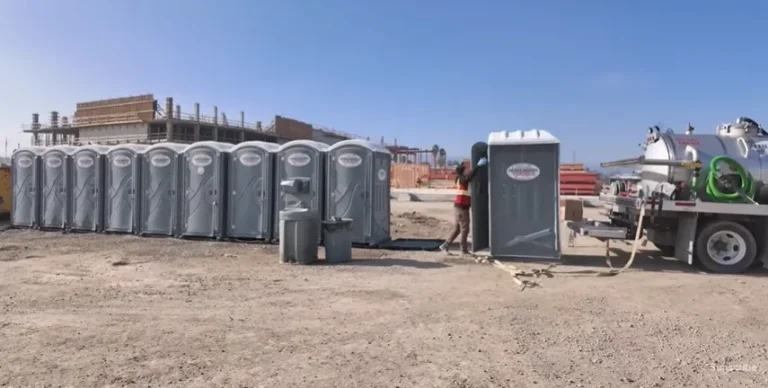
- Vacuum pump-out. A high-powered hose suctions the entire waste tank empty. This is the core of the visit — everything else is cosmetic without it.
- Interior wash-down. The tech scrubs and sanitizes the seat, walls, floor, and high-touch points (door handle, latch, paper holder) with commercial-grade cleaners.
- Chemical recharge. Fresh water goes in, plus new deodorizing and sanitizing chemicals. This is what keeps the unit smelling neutral between visits.
- Supply restock. Toilet paper refilled, hand sanitizer topped up. If the unit ran dry mid-week, guests went without — which tells you something about the schedule (more on that below).
- Damage and function check. The tech checks the door latch, vent stack, seat integrity, and looks for graffiti, tipping risk, or tank leaks.
- Exterior wipe and site check. A quick wipe of the outside, and a glance at placement — still level, still accessible for the truck next week.
That’s what “servicing” means every time someone says it in this business. If your provider’s “service” is just a pump-out with no wash-down and no restock, you’re not getting a service — you’re getting a vacuum job.
Not sure your units are on the right service schedule?
Mon–Sat 7AM–7PM · Sun 7AM–12PM · 24/7 emergency service
Service Interval Table: Usage Level → Recommended Schedule
Here’s the table to bookmark. Find your usage level, read across for the recommended service interval:
| Usage Level | Typical Scenario | Recommended Service Interval |
|---|---|---|
| Very light | Single unit, 1–5 people/day (small office reno) | Every 1–2 weeks* |
| Standard | Crew of ≤10 on a 40-hr week, or 1 unit per 50 guests | Weekly (industry standard) |
| Moderate | Crew of 10–20, or busy single-day event | Weekly to twice weekly |
| Heavy | 20+ daily users per unit, large multi-day events | Every 1–3 days |
| Extreme | Festivals, concerts, all-day public events in summer | Daily, plus on-call standby |
*Every-2-week servicing only where your provider agrees to it in writing. A common local best-practice guideline for in-service units is cleaning and waste removal at least weekly — treat weekly as the safe default and push beyond it only for genuinely light use.
Notice the pattern: it’s almost never the calendar that sets your schedule — it’s the traffic. A unit on a quiet site can stretch a week comfortably; a unit at a Belle Isle wedding with 150 guests and an open bar earns its service in a single afternoon.
6 Factors That Shorten Your Service Window
The table above is the baseline. These six factors pull your interval shorter:
- Headcount. Every extra user burns through the ~150-use capacity faster. Double the people, halve the interval. This is the factor that matters most, and it’s the one planners underestimate.
- Event vs. construction. Job sites spread usage across the day in a steady drip. Events — especially with alcohol — create surges: a beer-tent crowd can burn through half a tank between 7 and 10 p.m. Surge usage needs shorter intervals, full stop.
- Detroit summer heat. This one is local and real. Waste breaks down faster in heat, the deodorizing chemicals burn off quicker, and the vent stack works harder. A unit that’s fine for seven days in October gets pungent by day four in a July heat wave. For summer events, plan the shorter interval in the table, not the longer one.
- Food and alcohol. Both drive more restroom visits — alcohol especially. If your event has a bar, treat your usage level as one row heavier than the headcount alone suggests.
- Fewer units than the math calls for. Every unit you skip pushes its share onto the others. Under-ordering by one unit on a 10-unit festival order means each remaining unit absorbs about 11% more traffic — that’s the difference between “fine until Monday” and “needs service Sunday morning.”
- Long rental, neglected mid-term. This is the quiet killer for construction rentals. The first three weeks go fine on weekly service, then the crew doubles for the rough-in phase — and nobody tells the rental company. Any time your site population changes significantly, re-evaluate the schedule.
⚠️ Never empty a unit yourself
Waste pump-out and disposal must be handled by professionals with proper equipment and disposal at permitted facilities. Pouring it into a dumpster, a drain, or a ditch is illegal and a genuine health hazard — and it will cost you far more than a service call when it gets reported. If a unit needs service between visits, call your provider for an extra pump-out. That’s what the 24/7 emergency service line is for.
7 Signs a Unit Needs Service NOW
Don’t wait for the calendar if you see any of these. A unit showing two or more is overdue today:
- You can smell it from outside the door. The vent stack is designed to pull odors up and out. If the smell is beating the vent, the chemicals are spent and the tank is near capacity.
- The waste level is visible and rising. Open the lid and look. If the level is within a few inches of the seat riser, you’re one busy afternoon from an overflow.
- The blue liquid is gone. Fresh service leaves the tank water visibly blue. When it’s turned murky brown or clear, the deodorizer and sanitizer are exhausted — even if the tank isn’t full yet.
- Supplies are empty. No toilet paper, dry sanitizer dispenser. Guests notice this instantly, and it signals the last service was either skipped or a long time ago.
- The floor and seat are sticky or grimy. A properly serviced unit shouldn’t feel tacky anywhere. Sticky surfaces mean the wash-down didn’t happen — or happened days too long ago.
- Guests are avoiding it. Watch behavior, not the calendar. When people start crossing the parking lot to use the gas station bathroom instead, the unit has failed its job.
- Complaints are rising. On a job site, grumbling about the restroom escalates fast — and on an event, it ends up in your reviews. Treat the first real complaint as the service alarm.
💡 Pro tip for Detroit event planners: book your service visit for the morning before your biggest day, not after the event. A Friday-afternoon wedding at a venue near Eastern Market wants its freshest service Friday morning — and keep the truck’s access path clear and unlocked so the tech can actually reach the units.
The Real Cost of Skipping Service
Stretching the interval feels like saving money. It isn’t. Here’s what “one more day” actually costs:
- Emergency pump-out fees. An unscheduled, rush service call costs more than a visit on the regular route — sometimes significantly. Providers charge for the detour.
- Mid-event replacement. If a unit becomes unusable during your event, you’re paying for emergency delivery of a replacement unit on top of the service. Weekend festival in July? Good luck with availability and pricing.
- Guest experience damage. For weddings, corporate events, and public festivals, restroom horror stories travel. Nobody remembers the catering; everybody remembers the porta potty.
- Job-site productivity. OSHA’s sanitation rules for construction sites put the duty of keeping facilities clean and serviceable on the employer. A crew standing around complaining about the restroom — or worse, leaving the site to find one — is a crew not working. And an inspector doesn’t need a stopwatch to see a neglected unit.
- Health risk. Overflowing or severely neglected units are a genuine sanitation hazard: bacterial exposure, insect breeding, and contamination of the surrounding area. The chemicals exist for a reason.
For the full pricing picture, see our guide to porta potty rental cost in Detroit.
Detroit Seasonal Notes: When the Calendar Changes the Answer
Detroit’s seasons don’t just change the weather — they change the servicing math:
Summer (June–August): festival season. This is peak demand and peak heat. Riverfront festivals, Hart Plaza events, Belle Isle weddings, outdoor concerts — big crowds plus 85°F+ days mean the shortest intervals in the table. For multi-day summer events, plan daily or every-other-day service, and put the provider’s emergency number in your phone before day one.
Construction season (April–October). Downtown, midtown, and highway crews run their biggest headcounts in these months. Weekly service is the baseline; large multi-trade sites often move to twice weekly during peak phases. When the crew size changes, call and adjust — don’t wait for the units to tell you.
Fall (September–November): wedding and tailgate stretch. Outdoor weddings run into October, and Lions tailgates run all fall. Cooler air helps with odor, but alcohol-heavy crowds keep usage surges high. Stick with the table, not the thermometer.
Winter (December–March): the freeze problem. Usage intervals can stretch in winter — cold slows bacterial activity and odor — but Michigan winters bring a different risk: standard units can freeze in sustained cold snaps, which damages tanks and makes servicing a mess. Winter rentals need freeze planning (winterized units or heated options like the restroom trailers we compare in porta potty vs restroom trailer). Don’t just extend the interval and forget the units exist — check on them.
Frequently Asked Questions
How long can a porta potty go without being serviced?
For standard use, about one week — that’s the industry standard, and a ~50–60 gallon tank holds roughly 150 uses. Heavy event use can cut that to a few days; very light use can stretch toward two weeks with your provider’s agreement.
What does a porta potty service visit include?
A full service includes vacuum pump-out of the waste tank, interior wash-down and sanitizing, fresh water and chemical recharge, toilet paper and hand sanitizer restock, and a quick check for damage or function issues.
Can I empty a porta potty myself?
No. Waste removal and disposal must be handled by professionals with proper equipment, and waste has to go to permitted disposal facilities. Call your provider for an extra pump-out between scheduled visits.
Does hot weather really mean more frequent servicing?
Yes. Heat accelerates waste breakdown and burns through deodorizing chemicals faster, so odors develop sooner. In a Detroit summer, plan the shorter service interval for your usage level — especially for outdoor events.
How much does extra servicing cost?
It varies by provider, but unscheduled pump-outs cost more than visits on the regular route because of the detour. That’s why getting the schedule right up front — see our Detroit rental cost guide — beats paying for rush calls later.
What happens if my rental runs longer than planned?
Call your provider and extend. Long-term rentals simply continue on the service cycle — weekly for standard use — for as long as the units are on site. The mistake is letting the project stretch while the service schedule stays frozen at the original plan.
Should construction sites service more often than events?
Not necessarily — it depends on headcount, not setting. A 10-person crew on a weekly cycle is the textbook case for the one-week rule. It’s large crews (20+) and high-surge events (festivals, concerts, open bars) that need twice-weekly or daily service.
Get the Right Service Schedule for Your Site or Event
- Mon–Sat 7AM–7PM · Sun 7AM–12PM · 24/7 emergency service
- We’ll connect you with Detroit-area providers for units, servicing schedules, and straight answers — no forms, no waiting.
Porta Potty Rental Detroit MI | 2211 Woodward Ave Suite 300, Detroit, MI 48201 | (313) 385-3332 | Mon–Sat 7AM–7PM · Sun 7AM–12PM, 24/7 emergency