Last Updated: November 20, 2026 · Rules checked: November 20, 2026
Quick answer: On a Michigan construction site, the toilet count does not come from federal OSHA — it comes from MIOSHA rule R 408.40129: 1–20 workers = 1 toilet, 21–40 workers = 2 toilets, then 1 more for every additional 40 workers. Michigan’s table is stricter than the federal one most websites print, and Michigan law says toilets must be serviced regularly and supplied with toilet paper. Get the count wrong and a serious violation can cost up to $7,000.
Search “OSHA toilet requirements construction” and almost every result hands you the same federal table from 29 CFR 1926.51. There is a problem with using it in Detroit: Michigan is a state-plan state. Private construction sites here are inspected by MIOSHA — the Michigan Occupational Safety and Health Administration — under Michigan’s own rules, and Michigan’s numbers are not the federal numbers.
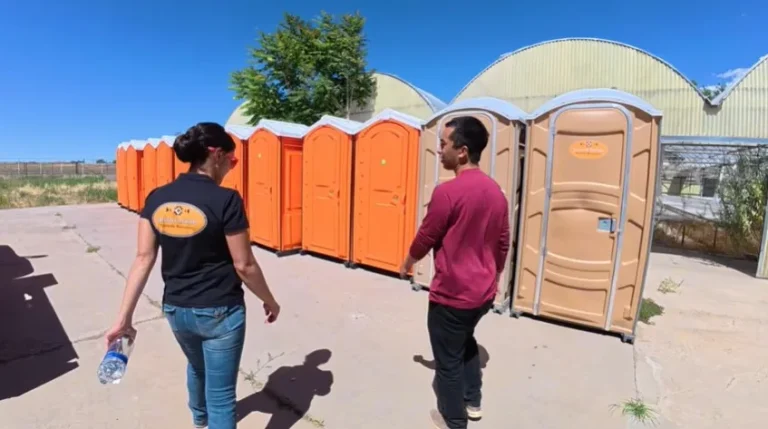
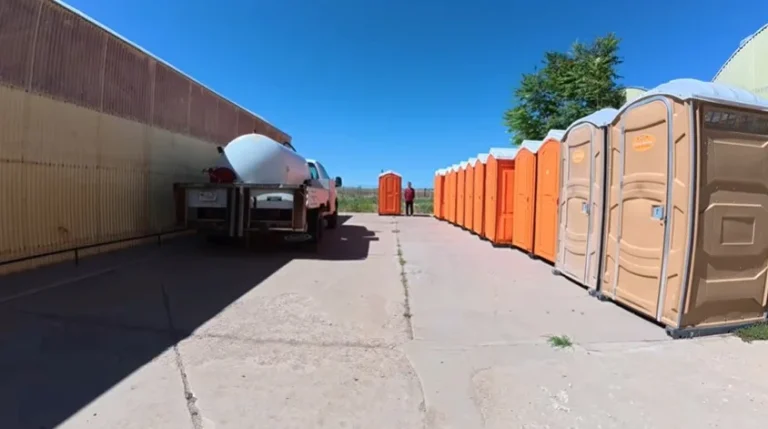
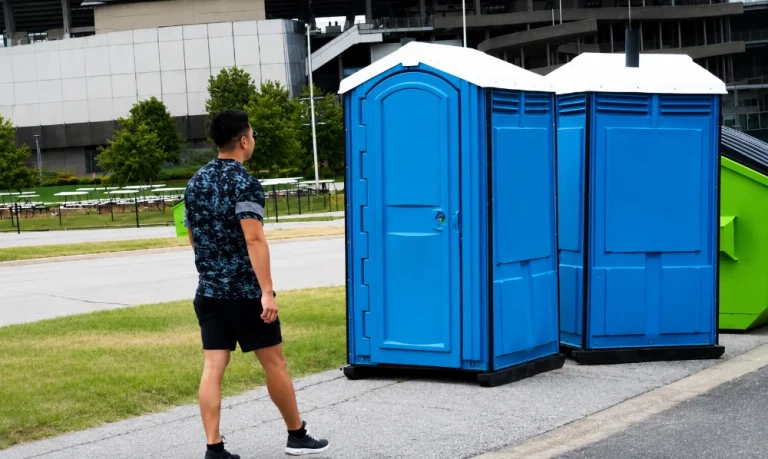
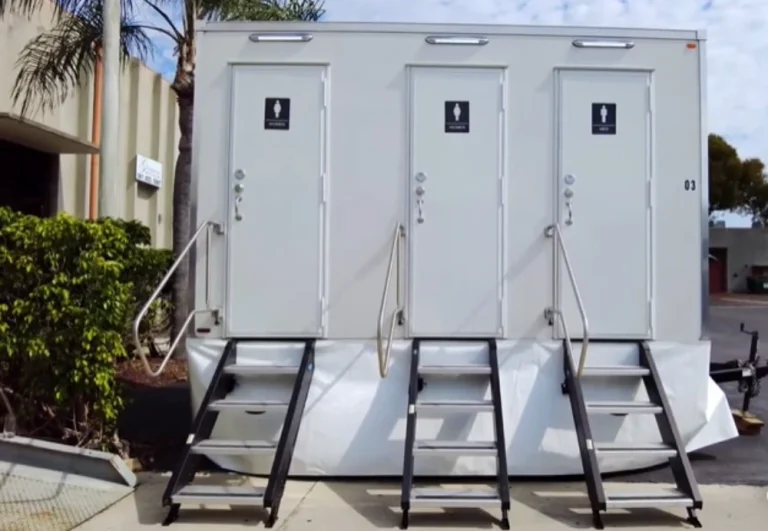
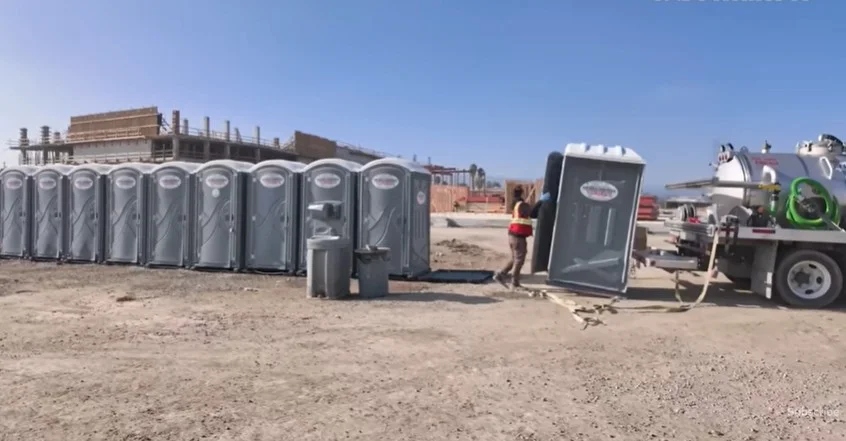
This guide gives you the table that actually applies on a Detroit job site, where it differs from the federal rule, and what else Michigan requires beyond the count. Setting up a site? Our construction porta potty rental page covers the units themselves; this post is about staying legal.
The MIOSHA table: how many toilets a Michigan crew needs
Michigan’s construction sanitation rule, R 408.40129, sets the minimum like this:
| Workers on site | Toilets required (MIOSHA) |
|---|---|
| 1–20 | 1 |
| 21–40 | 2 |
| 41–80 | 3 |
| 81–120 | 4 |
| Each additional 40 (or part of 40) | +1 |
Count everyone on site at the same time — your crew and the subcontractors working that day. The rule runs on employees present, and the day the inspector visits is the day your biggest crew is there, not your smallest.
Two things catch contractors out. First, the jump comes early: the 21st worker triggers the second toilet, not the 41st. Second, Michigan counts whole toilets — the federal table lets one seat plus one urinal cover a group of workers, but Michigan’s rule has no urinal shortcut. A standard porta potty is one toilet, and that is how MIOSHA counts it.
Planning something that is not a construction site — a wedding, a festival, a backyard party? Different math entirely, covered in our guide to how many porta potties you need for events and gatherings.
Federal OSHA vs MIOSHA: where the tables split
The federal standard, 29 CFR 1926.51(c) Table D-1: 20 or fewer workers need 1 facility; above that, 1 toilet seat and 1 urinal per 40 workers — and the table’s own last row, “200 or more,” drops the ratio to 1 seat and 1 urinal per 50 workers. Side by side, the gap is not academic:
| Workers | Federal OSHA (seats + urinals) | MIOSHA (toilets) |
|---|---|---|
| 20 | 1 | 1 |
| 30 | 1 seat + 1 urinal | 2 |
| 100 | 3 seats + 3 urinals | 4 |
| 200 | 4 seats + 4 urinals | 6 |
Read the 30-worker row carefully, because that is the size of half the commercial jobs in metro Detroit. A contractor who orders off a national website’s federal table puts one seat and a urinal on site. A MIOSHA inspector counts toilets and finds the site one short — on day one. The federal table even steps down at the top: at 199 workers its per-40 math gives 5 seats and 5 urinals, but at 200 the per-50 bracket gives 4 of each — while Michigan’s ladder just keeps climbing at the same rate.
Why can Michigan use its own table? A state plan is federally approved on condition it is at least as effective as the federal program — it may be stricter, and on toilet counts Michigan is. Federal OSHA still covers federal employees and a few special cases here, but a private contractor building in Detroit answers to MIOSHA.
Beyond the count: what else Michigan’s rule requires
The ratio is the part everyone quotes, but R 408.40129 says more than the count. Part of it mirrors the federal rule — and two duties, servicing and toilet paper, are written into Michigan’s text where the federal construction standard is silent:
- No sewer, no problem — chemical toilets are named in the rule. Where no sanitary sewer or water is available, the rule allows privies, chemical, recirculating or combustion toilets (unless a local code prohibits them) — the same four options the federal rule lists at 1926.51(c)(3). A standard porta potty is a chemical toilet, so the unit itself is not the risk — the count and the condition are.
- Servicing is in the rule, not just recommended. Rule 408.40129(4): “To assure sanitation, a toilet shall be serviced and maintained on a regular basis.” A unit that was legal on delivery day can stop counting if it is left to fill up — see the next section.
- Toilet paper is in the rule too. Rule 408.40129(5) requires every toilet to be supplied with toilet paper. It sounds too small to cite anyone over, until an inspector opens your only unit and finds an empty holder.
- The mobile-crew exception is narrower than it sounds. Crews that genuinely move location daily or hourly — utility line crews are the classic example — may instead be transported promptly to nearby facilities. Federal OSHA’s 2002 interpretation letter is clear that a fixed project crew does not become a “mobile crew” by calling itself one.
“Provided” means usable: condition and access count too
Both MIOSHA and federal OSHA use the word “provided,” and inspectors read it strictly. In a May 17, 2006 interpretation letter, federal OSHA stated that a toilet in an unsanitary condition is not “provided” at all — it does not count toward your required number, however many units are physically on site. The same letter points to the ANSI Z4.3 servicing guide: a unit used by 10 or fewer people serviced at least weekly, and one toilet serving a full crew of 20 serviced twice a week. Michigan’s “regular basis” wording points the same direction. Our breakdown of how long a porta potty can go without being serviced works through the timing.
Access is the other half. Federal letters use a practical benchmark: workers should reach a toilet promptly, generally in under 10 minutes. A February 2005 letter dealt with high-rise work where every toilet sat on the ground floor — the count was right and the setup still failed, because “provided” also means reachable without a long trip and a long line. On a taller Detroit project, that can mean units on more than one level.
Handwashing: what the rule requires, and what inspectors expect
Here is a place where rental blogs routinely overstate the law, so here is the honest version. Michigan’s washing rule, R 408.40130 (mirroring federal 1926.51(f)), requires adequate washing facilities where employees work with paints, coatings, herbicides, insecticides or other harmful contaminants — and lavatories with running water, soap and towels or air blowers in places of employment. No sentence in the construction rules says “a handwash station at every toilet,” and any post claiming otherwise is embellishing.
In practice: a crew handling concrete, solvents or coatings triggers the washing requirement on its own, and a handwash station next to the toilets is how most Detroit sites satisfy it. Treat the station as standard equipment on any site with contaminant work — which is most of them.
What it costs to get it wrong in Michigan
MIOSHA penalties are set by state law (MCL 408.1035). They are lower than the federal figures most websites quote — and they are the numbers a Michigan contractor will actually face:
- Serious violation: up to $7,000 per violation
- Other-than-serious: up to $7,000
- Willful or repeated: up to $70,000 (with a $5,000 minimum for willful)
- Failure to correct: up to $7,000 for each day the failure continues beyond the correction period
For comparison, federal OSHA’s maximums are $16,550 for a serious violation and $165,514 for willful or repeated — the January 2025 amounts, which remain in force through 2026 because federal OSHA made no inflation adjustment for 2026. A site that is short a unit and has an unserviced unit is looking at more than one line on the citation. One caution: a bill introduced in Lansing in 2025 (SB 49) proposes raising MIOSHA’s caps to the federal levels; it had not been enacted when this post was checked in November 2026. Order the extra unit — it is cheaper than the math above.
Detroit contractor compliance checklist
- Count the real headcount — your crew plus every sub on site that day, at peak.
- Order to the Michigan table — 1 toilet to 20 workers, 2 at 21–40, +1 per additional 40.
- Place units the crew can reach promptly — think under 10 minutes, and rethink placement as the building grows.
- Schedule servicing before you need it — weekly at minimum, twice a week when one unit serves close to 20 workers.
- Keep toilet paper stocked — a written Michigan requirement, not a courtesy.
- Add handwashing where contaminant work happens — concrete, coatings, solvents, pesticides.
- Include an accessible unit where accessibility rules apply — our ADA porta potty requirements guide explains when.
- Recount when the crew grows — the phase where a second crew arrives is when compliant sites quietly stop being compliant.
Frequently asked questions
1. How many toilets does OSHA require on a construction site?
In Michigan, MIOSHA’s table applies: 1 toilet for 1–20 workers, 2 for 21–40, and 1 more for every additional 40 workers. The federal OSHA table (29 CFR 1926.51, Table D-1) is different — 1 seat and 1 urinal per 40 workers — and it is the one most national websites print. On a Michigan site, follow the MIOSHA numbers.
2. Does federal OSHA or MIOSHA inspect a Detroit construction site?
MIOSHA. Michigan runs a federally approved state plan covering private employers, so MIOSHA inspectors enforce Michigan’s rules — including R 408.40129 — on Detroit job sites. Federal OSHA covers federal employees and a few special cases — not a private contractor’s site.
3. Does a porta potty count as a compliant construction toilet?
Yes. Where no sanitary sewer or water is available, Michigan’s rule expressly allows chemical toilets, which is what a standard porta potty is. Compliance then depends on the count, placement, regular servicing and toilet paper — a dirty or unstocked unit can stop counting as “provided.”
4. How often do construction site toilets have to be serviced?
Michigan’s rule requires servicing “on a regular basis” without naming a day count. Federal OSHA’s guidance points to ANSI Z4.3: at least weekly for a unit used by 10 or fewer people, twice a week for one toilet serving 20. An unsanitary toilet does not count toward your required number at all.
5. Are handwashing stations legally required next to construction toilets?
Not by a blanket sentence in the construction rules. Washing facilities are required where crews work with harmful contaminants such as paints, coatings and pesticides. In practice, most Detroit sites put a handwash station with the toilets — and any site with contaminant work should.
6. What is the fine for not having enough toilets on a Michigan site?
A MIOSHA serious violation carries up to $7,000 per violation; willful or repeated violations up to $70,000; failing to correct a cited problem can add up to $7,000 for each day the failure continues. Those are Michigan’s caps under MCL 408.1035 — lower than federal OSHA’s, but the ones that apply here.
7. Do subcontractors count toward the toilet ratio?
Count the people actually on site. The rule is written around employees present, and an inspector at your gate sees one combined headcount — your crew plus every sub working that day. Plan for the busiest day of the phase, not the average day.
Sources: 29 CFR 1926.51, Table D-1 (eCFR, current text); MIOSHA Construction Safety Standard Part 1, R 408.40129–408.40130; MCL 408.1035; OSHA’s civil penalties page and its May 21, 2026 penalty-adjustment memo; OSHA standard interpretation letters of June 7, 2002, February 23, 2005 and May 17, 2006. Rules and figures checked November 20, 2026.
Setting up a compliant site in metro Detroit
Order to the Michigan table, not the federal one, and the rest is logistics. Porta Potty Rental Detroit MI delivers across Detroit, Wayne County and metro Detroit — call before noon and most Wayne County sites are set the same day, by 4 pm. Every rental is flat-rate, with servicing on the schedule your headcount needs. Call (313) 385-3332 and tell us the crew size; we will spec the count against R 408.40129, not a national blog’s table.